
AI Isn’t Killing Commercial Real Estate. It’s the Most Disruptive Landlord It’s Ever Had.

The Real Deal ran a debate this week: will AI kill commercial real estate?
It's the wrong frame.
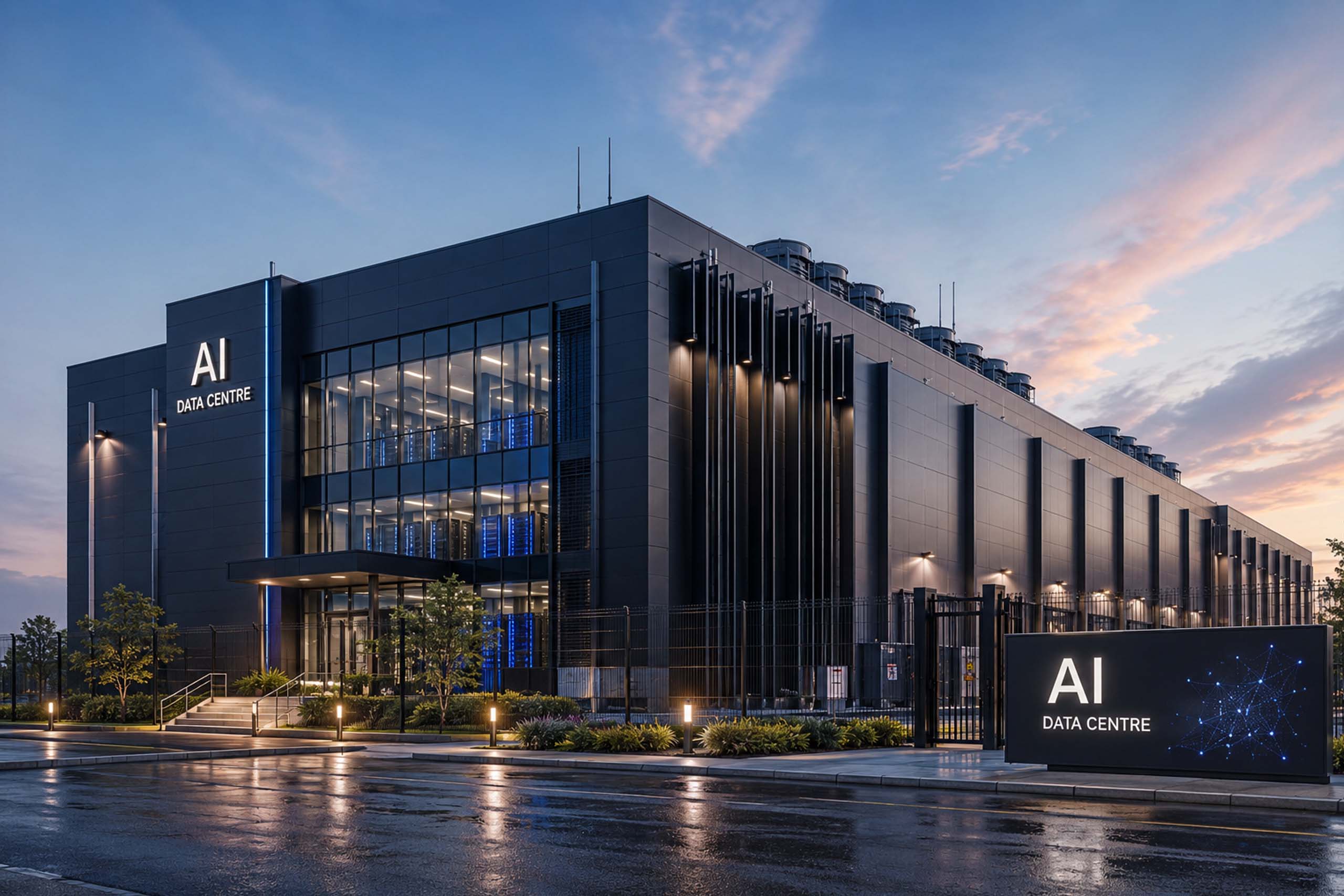
In mid-May, Meta cut 8,000 employees. In the same earnings call, the company raised its 2026 data center spending forecast to $125-145 billion. Up 8 percent from its prior estimate.
That's not a company abandoning the physical world. That's a company restructuring who occupies it. Fewer humans in offices, more capital poured into the infrastructure that runs AI. Both at the same time.
AI isn't pulling capital out of commercial real estate. It's redirecting it. And that distinction changes everything about how you think about which assets survive.
What's Happening
The bear case is real. Mizuho's Vikram Malhotra estimates that if legal, finance, and accounting roles automate at scale, office-using job growth could slow from its historical 2-3 percent per year to around 0.5. His tell: watch sublet volumes and renewal rates. His geography: coastal markets — New York, Boston, San Francisco — most exposed, because those are exactly the cities where the high-risk occupations concentrate.
The bull case is also real. JLL's Sarah Mancuso points out that AI companies themselves are occupying office at a historic pace. The Bay Area alone holds roughly 17 million square feet of AI-occupied space today. JLL projects another 20-35 million square feet of AI-firm demand by 2030. Meanwhile, CRE Daily reported this week that data center land deals have surged 141 percent, reshaping the U.S. development market entirely.
AI is simultaneously the largest potential source of office demand destruction and the largest driver of new physical infrastructure investment in a generation. Both poles are active at the same time.
This is not a story about one thing winning. It's a story about a massive reallocation.
The capital that would have gone into commodity office is going to data centers. The capital that's left in office is concentrating in the buildings that can do something a data center can't: bring people together in a way that matters.
Look at what's happening inside the buildings in our portfolio over the last 30 days compared to the prior 30. Outdoor space bookings up 53 percent. Kitchen reservations up 38 percent. Lounge bookings up 12 percent. Event space up 10 percent.
The other column: game rooms down nearly 20 percent. Sleep pods down 16 percent. Quiet rooms down 13 percent.
The individual-use spaces are declining. The social, gathering, and activation spaces are growing.
That's not a coincidence. That's AI-augmented work showing up in behavioral data. People are doing their focused individual work elsewhere — at home, through tools that are getting rapidly better at enabling it. What they're coming to the building for is what those tools can't replicate: the informal meeting, the outdoor lounge conversation, the event, the kitchen run-in that becomes a collaboration.
Why It Matters
Leesman has been measuring this from the employee side for over a decade, across more than a million workplace survey responses. The average office scores 69.5 on the Leesman Index. Home scores 79.5.
But the data says where that gap lives. Home wins on individual focused work, private calls, creative thinking. Office wins on informal social interaction, learning from others, collaboration, hosting visitors.
As AI gets better at enabling individual work anywhere, home's advantages in the individual column compound. And the office's advantages in the social column become more specific — and more valuable.
Leesman+ certified buildings — those scoring 70.0 or higher — already narrow the list of activities where home wins from 10 down to just 4. They've figured out what the office is actually for in this environment. That's the category of asset that survives the reallocation.
What to Do
If you're tracking whether AI is good or bad for your portfolio, stop looking at the macro debate and start looking at the booking data.
A building where social and gathering space activation is growing quarter over quarter is a building that tenants need for what AI can't provide. Those tenants aren't leaving because of an efficiency review.
A building where the individual-use amenities are the only thing running — hot desks, quiet pods, game rooms — is competing on the wrong axis. AI is getting better at enabling exactly what those spaces offer. The tenants doing their individual work there are the most likely to ask whether they need the building at all.
AI is redirecting trillions of dollars of capital in commercial real estate. Data centers are getting it. The best experiential office assets are getting it. The commodity middle is getting hollowed out.
Anyways. The question isn't whether AI kills CRE. It's which pole your building is on.