
New York Froze $10 Billion of Data Centers. Office Landlords Just Lost Their Favorite Excuse.
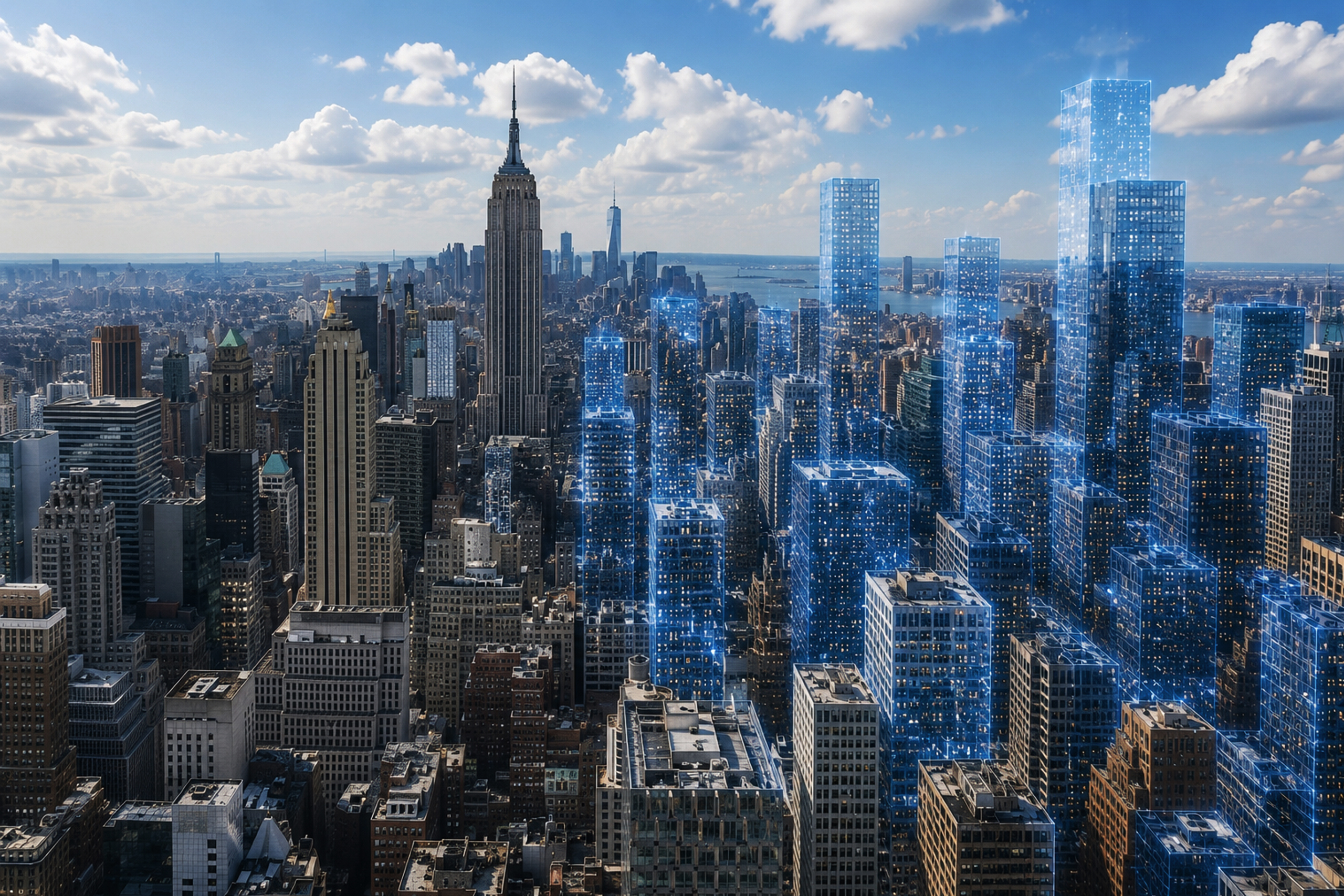

On Tuesday, Governor Hochul signed the nation's first statewide moratorium on hyperscale data centers. Environmental permits for anything 50 megawatts and up are paused for as long as a year while the state writes a new rulebook. Bisnow pegged the frozen development pipeline at roughly $10 billion. New York is the first state to hit pause on the AI buildout. It won't be the last.
What's Actually Happening
Data centers have spent three years as the one asset class in commercial real estate with something close to infinite demand. We've called them the new railroads on The Quantum City Show, and the capital agrees: the AI buildout is a trillion-dollar real estate and energy story. But the constraint was never demand. It was the grid, and the neighbors. The executive order names ratepayers, the environment, and communities in its first breath. When your asset class starts showing up in voters' electric bills, politics shows up in your permit file. (Nothing mobilizes a legislature like a rate hike in an election year.)
Here's why office owners should care, and not in the abstract. For two years, the data center conversion has been the escape-hatch story for obsolete office. Roughly 30% of American office buildings are functionally obsolete, about $1.1 trillion of stock, and the most exciting answer to "what do we do with them" has been to sell them to someone who'll fill them with servers. Chicago's old Board Options Exchange went that way. Plenty of pro formas quietly assume the same exit. In New York, that exit just closed for at least a year. Every other state with a stressed grid is watching.
Why It Matters
If you can't convert your way out, you have to compete your way out. The timing is almost funny, because the behavioral data says mid-July is exactly when the competition shows.
This is supposed to be the office's dead season. Summer Fridays, empty lobbies, out-of-office replies. Our portfolio says otherwise. The busiest building-access week of the entire quarter was last week. Mid-July. Not a September Tuesday.
The sharper signal is Friday. Through spring, our Friday entries were sliding double digits, right in line with every national tracker. In the last four weeks, Friday flipped: its share of weekday entries grew from roughly one in seven to nearly one in four, making it the single busiest day in the portfolio. Visitor traffic tells the same story. It fell almost 40% heading into the July 4 week, then rebounded past its late-June level within two weeks.
Leesman's research explains why this is possible. About a third of employees now have no fixed office routine at all, and only 62% are satisfied with their commute. Presence is fluid, and the commute has to be earned. Fluid cuts both ways: people who aren't required to show up on a Friday can be won on a Friday. Summer programming, events, the stuff that looks soft on a budget line, is what our access data responds to within weeks.
What to Do
First, stop underwriting the conversion fantasy as your plan B. If your building's backup plan was servers or apartments, New York just showed how fast a state can take an option off the table. You have two honest choices: sell the problem, or fix the product.
Second, treat summer as your test lab. The buildings winning July Fridays aren't winning on square footage. They're winning on a reason to come in. Find your softest day, program against it, and watch the access data. Ours moved inside a month.
The conversion story was always a way to dodge the harder question: is your building worth showing up to? New York just made that question mandatory for a year. The buildings that can answer it were never waiting on a data center deal anyway.
The moratorium didn't pause demand. It paused the excuse.